Why I Use Humour In Dark Fiction
Why I Use Humour in Dark Fiction
I write dark fiction, which means I spend an unreasonable amount of time thinking about questionable morality and the various ways humans can make an already terrible situation considerably worse.
Naturally, I think some of it is fucking hilarious.
Not the actual horrible things, obviously. I feel like that clarification probably shouldn't be necessary, but this is the internet and someone somewhere is already warming up their keyboard and priming the caps lock key.
Humour has always been how I deal with things that are uncomfortable, frightening, painful or just spectacularly shit. If something goes wrong, there's a very good chance I'll make a joke about it before I've properly processed what happened. Sometimes three business days before.
So when I started writing darker fiction, humour came with me.
I don't consciously sit down and think, This chapter has been miserable for six pages, better deploy a joke. It happens because my characters are people, and people are weird. We make inappropriate jokes at funerals. We laugh when we're nervous. We say completely ridiculous things in the middle of arguments. Sometimes something is so catastrophically awful that the only two available responses are crying and laughing, and frankly I've already got mascara on and it's cheap enough not to be waterproof.
Darkness doesn't suddenly make everyone solemn and eloquent. In fact, I think humour becomes more important the darker a story gets.
If every page is relentlessly bleak, eventually the darkness stops feeling dark. There's nowhere further down to go. Everything exists at the same emotional volume until murder, trauma and somebody dropping their toast butter-side down somehow begin occupying the same dramatic territory.
Humour gives darkness contrast. It lets you breathe.
Then I can ruin your day again.
People Are Still People When Everything Goes Wrong
One of the things I love about writing humour into dark situations is that it keeps the characters human.
Someone can be terrified and still notice something absurd. They can be furious and accidentally say something funny. They can love somebody deeply and still think they're an absolute fucking idiot. Seven weeks visiting an ICU taught me that faster than any other life lesson.
Actually, I think they're often what make difficult scenes believable.
Real people don't conveniently become serious when something terrible happens. Their personalities don't disappear because the plot has become dangerous. The sarcastic person is probably still sarcastic. The person who uses humour when they're uncomfortable is probably going to become even more inappropriate. The person who laughs at precisely the wrong moment will inevitably choose the worst possible moment imaginable because the human nervous system enjoys sabotage.
That's interesting to me.
I don't want characters who only exist to react correctly to the genre they're in. I want them reacting like themselves.
Humour Isn't the Opposite of Darkness
There's also this strange assumption that if something is funny, it somehow makes the darker material less serious. I don't agree.
Humour doesn't have to undermine darkness. Used properly, it can make it hit harder.
Give someone a moment of safety and the next threat feels sharper. Let characters laugh together and suddenly there's something worth losing. Allow the reader to relax for half a page and they'll lower their guard just enough for you to emotionally mug them around the next corner in a balaclava.
Writing is a beautiful profession. There's a rhythm to it. Tension and release. Horror and normality. Fear and ridiculousness. If everything is awful all the time, awful becomes normal. But put something warm, stupid or genuinely funny beside it and suddenly you can see exactly how dark the darkness is. Or to quote something I once heard somewhere and can't remember:
Without the bad times, the good times never feel so good.
Or something to that effect anyway.
That's probably why some of my favourite moments aren't necessarily the murders, threats or massive revelations. They're the stupid conversations happening around them. The tiny bits of humanity stubbornly surviving while everything else goes spectacularly to shit. And it always goes to shit.
I Also Refuse to Take Myself That Seriously
This is probably the less literary explanation.
I can't.
I can spend hours researching something horrifying for a book, construct an elaborate psychological motivation for a character, carefully layer clues through several chapters and then become completely distracted because I've realised one tiny part of the premise is objectively ridiculous.
Once I've noticed it, we're fucked.
That's how my brain works. It pokes things. It asks questions nobody invited it to ask. It wanders directly past the sensible interpretation and starts investigating whatever weird little detail is hiding behind it. And honestly, I don't want to edit that out of my writing.
There are plenty of books that maintain an intensely serious atmosphere from beginning to end, and some of them are brilliant. They're just not mine. My stories can be violent, disturbing, uncomfortable and occasionally make you question whether I should be allowed unrestricted access to Google, the internet in general, or any implement I could use as both a writing tool and a weapon.
But they'll probably also make you laugh.
Sometimes at an inappropriate moment. (Especially at an inappropriate moment.)
Because darkness and humour aren't opposites to me. They've always existed in the same place. Sometimes things are horrible. Sometimes things are absurd. More often than not, they're both.
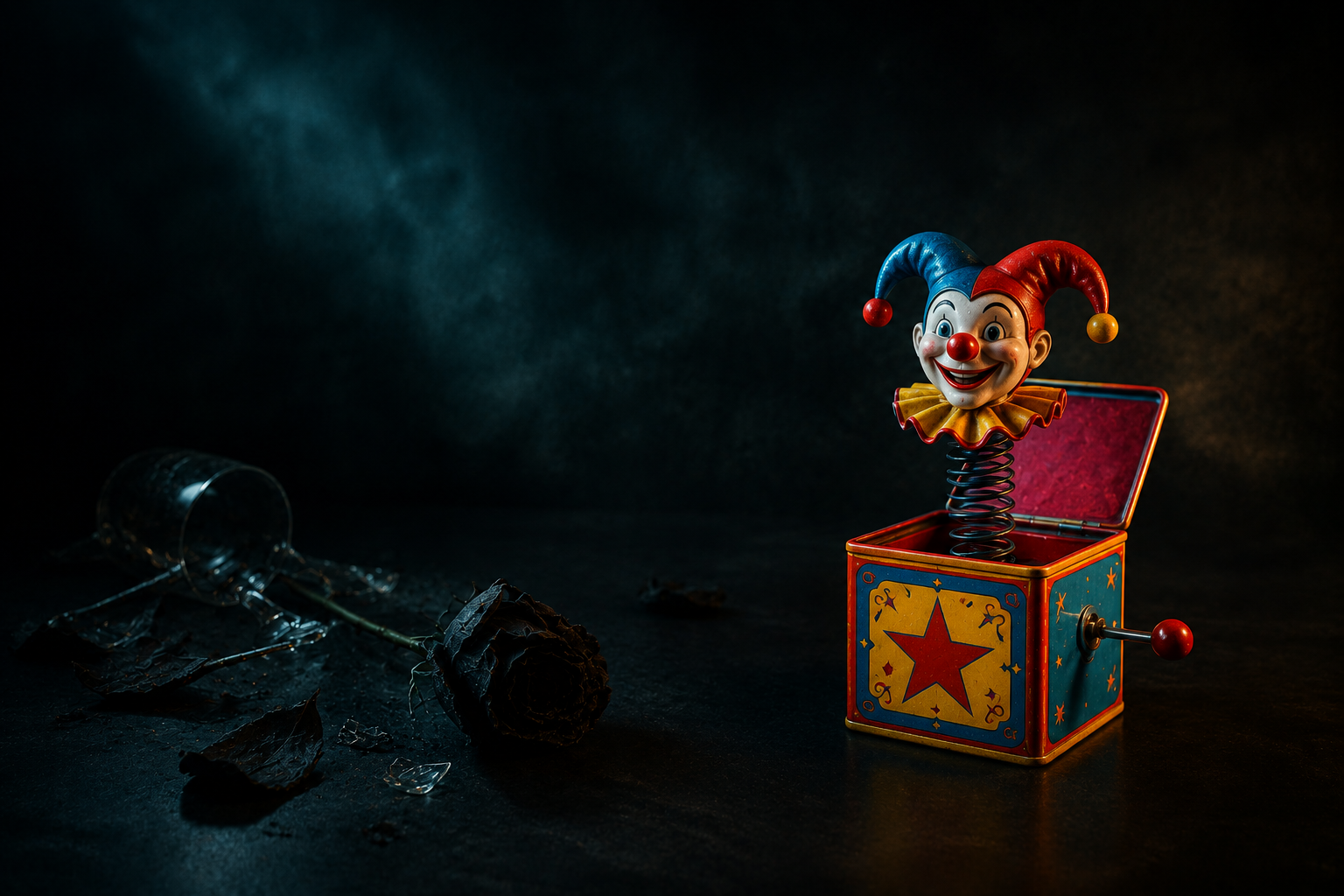
And if everything is going to shit anyway, someone might as well leave a brightly coloured jack-in-the-box sitting in the corner grinning at it.